The Multi-Messenger Revolution
Credit: Arc Centre of Excellence for Gravitational Wave Discovery
The Journey to Multi-Messenger Astronomy
Astronomy is one of humanity's oldest sciences. Ancient observers studied the heavens with only their eyes, aided by dark skies free from modern light pollution. Thousands of years later, inventors in the middle east engineered the first glass lenses to focus light. A few hundred years later, Galileo revolutionized astronomy by turning a telescope - invented by Dutch craftsman Hans Lippershey - toward the sky. For centuries after, astronomers could only observe visible light. But throughout the 20th century, technological breakthroughs opened the entire electromagnetic spectrum, from radio waves to gamma rays. This era of "multi-wavelength astronomy" revealed an invisible universe.
August 17, 2017: The Day Everything Changed
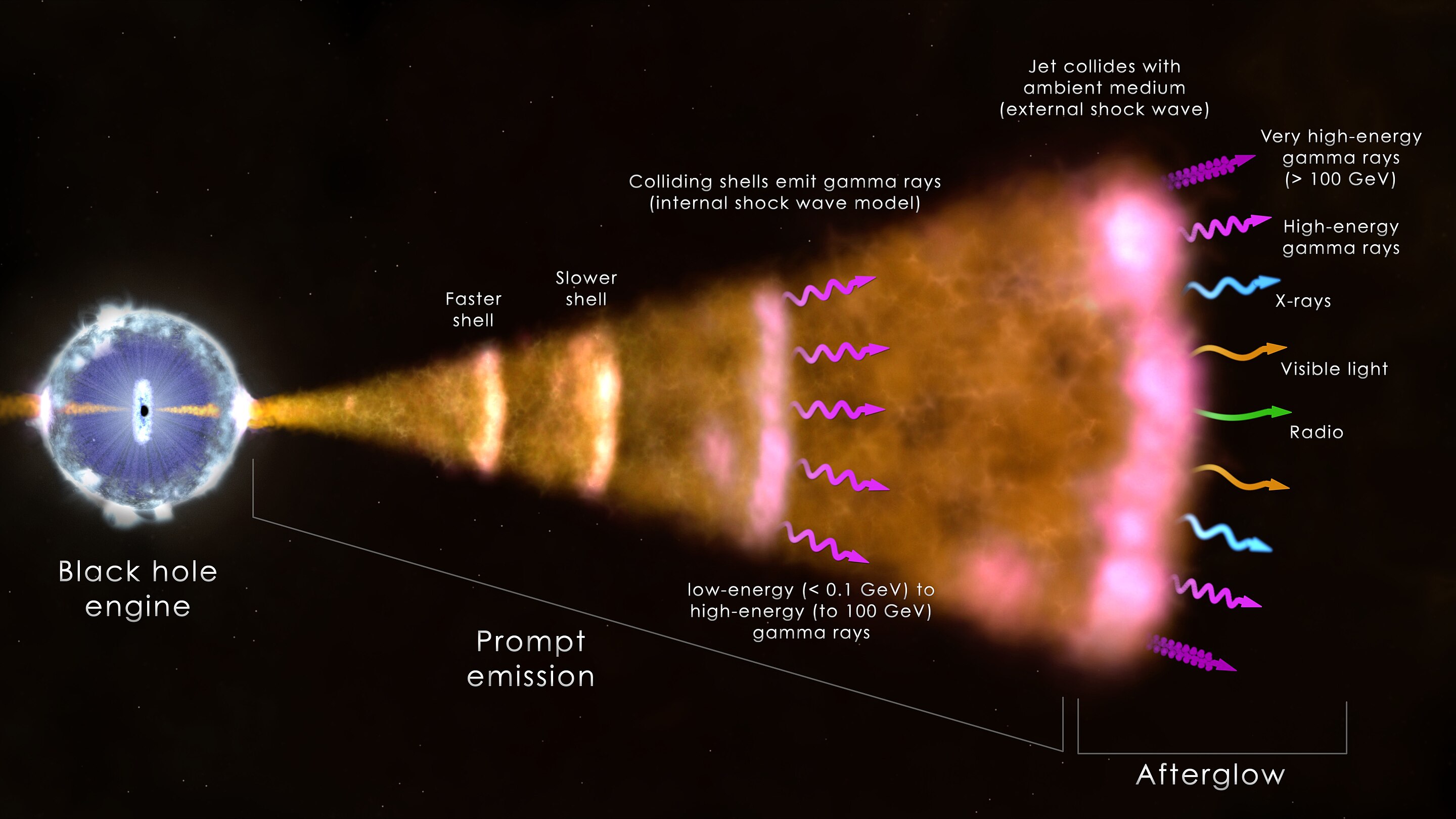
Then came August 17, 2017 - a turning point. For the first time ever, scientists detected both gravitational waves (ripples in spacetime) AND light from the same cosmic event: two neutron stars colliding 130 million light-years away. The gravitational wave signal, named GW170817, arrived first. Within seconds, satellites detected a gamma-ray burst (GRB170817A). Hours later, telescopes worldwide spotted the optical counterpart - a kilonova called AT2017gfo. This single event launched "multi-messenger astronomy": combining gravitational waves, light, neutrinos, and cosmic rays to decode the universe's most violent phenomena.
Why Multi-Messenger Astronomy Matters
Multi-messenger astronomy is revolutionizing science across multiple fronts:
Understanding Extreme Physics: These observations probe matter at densities impossible to recreate on Earth, revealing how neutron stars behave inside and confirming that colliding neutron stars forge heavy elements like gold and platinum.
Cosmic Measurements: By comparing gravitational wave data with optical observations, scientists can measure the universe's expansion rate independently, helping resolve one of cosmology's biggest puzzles.
Testing Fundamental Laws: Multi-messenger events let us test Einstein's theory of gravity in extreme conditions and measure whether gravitational waves truly travel at the speed of light.
In this new era, ground-based telescopes work alongside gravitational wave detectors, neutrino observatories, and gamma-ray searching space-based satellites. With each messenger, we reveal something no single instrument could see alone.